NJ Paycheck Calculator
Understanding your real income after taxes can feel confusing. That’s where a nj paycheck calculator becomes incredibly helpful. Whether you earn a salary or work hourly, a new jersey paycheck calculator lets you estimate your take-home pay after federal taxes, state deductions, and benefits.
A modern paycheck calculator or payroll calculator helps workers quickly estimate their net pay. Instead of guessing, you can see exactly how much money lands in your bank account each pay period. A take home pay calculator considers federal tax, Social Security, Medicare, New Jersey income tax, and optional deductions like retirement contributions.
If you’re an employee, freelancer, HR professional, or employer, using a reliable nj paycheck calculator can help you plan budgets, estimate tax withholding, and understand your earnings better.
Free NJ Paycheck Calculator – Calculate Your Take-Home Pay Instantly
A calculator for paycheck estimates your real income after taxes and deductions. By entering a few simple details, you can quickly calculate how much of your earnings you’ll actually receive.
A calculator paycheck tool usually asks for information such as your income, filing status, and deductions. The pay calculator then automatically estimates federal and state taxes to determine your final earnings.
With a paycheck tax calculator or payroll check calculator, you can:
- Calculate paycheck taxes instantly
- Estimate your net pay after deductions
- Compare salary vs hourly earnings
- Understand federal + New Jersey tax impacts
- Plan your monthly or yearly finances
Most tools support both salary and hourly calculation, making it easy for employees across different industries to estimate their income accurately.
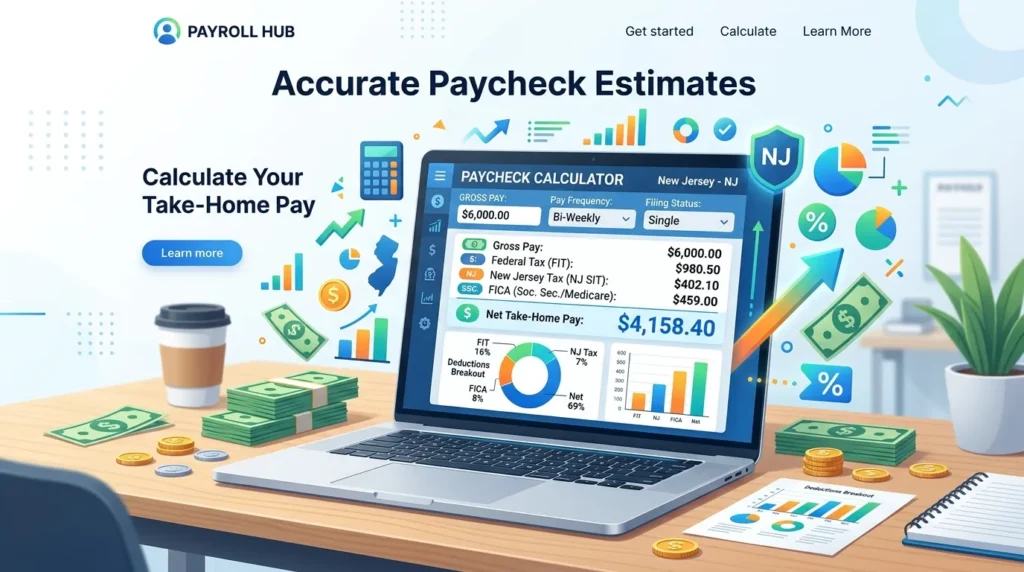
Use the New Jersey Paycheck Calculator
A good new jersey paycheck calculator works by collecting several pieces of payroll information and then applying federal and state tax rules.
Below are the main sections used in most paycheck tools.
Earnings
Your earnings determine the starting point for payroll calculations. This is commonly referred to as gross pay, which represents your income before taxes or deductions.
Common earnings inputs include:
- Hourly wage
- Annual salary
- Overtime hours
- Gross pay per pay period
- Pay frequency
A hourly paycheck calculator is useful for workers paid by the hour, while a salary paycheck calculator helps full-time employees estimate yearly earnings.
For example:
| Earnings Type | Example |
| Hourly wage | $25 per hour |
| Annual salary | $65,000 |
| Overtime | 10 hours |
| Gross pay | $2,500 per pay period |
These inputs allow the payroll calculator to determine taxable wages.
Pay Frequency
Your pay schedule affects how taxes are calculated for each paycheck. A weekly paycheck calculator distributes income across more pay periods than a monthly one.
Common pay frequencies include:
- Weekly – 52 paychecks per year
- Bi-weekly – 26 paychecks per year
- Semi-monthly – 24 paychecks per year
- Monthly – 12 paychecks per year
A bi weekly paycheck calculator is the most common format in the United States.
Different pay frequencies change how taxes and deductions appear on each paycheck.
Federal Taxes
Federal taxes are one of the largest deductions from a paycheck. A federal paycheck calculator estimates how much tax is withheld based on your income and tax filing information.
Important inputs include:
- Filing status (single, married, etc.)
- Dependents
- W-4 form details
A federal income tax calculation uses progressive tax brackets. The federal withholding calculator estimates how much tax your employer must deduct from each paycheck.
New Jersey State Taxes
In addition to federal taxes, workers in New Jersey must pay state income tax.
A new jersey income tax calculator applies state tax brackets to determine your withholding amount.
New Jersey uses a progressive tax system, meaning higher incomes pay higher tax rates.
Key factors include:
- NJ tax brackets
- State withholding allowances
- Rate codes assigned by employers
These values help a nj paycheck calculator tax tool determine the correct amount of state tax.
Benefits & Deductions
Many employees choose workplace benefits that reduce taxable income.
A paycheck calculator with deductions accounts for both pre-tax and post-tax deductions.
Common deductions include:
Pre-tax deductions
- 401k contributions
- Health insurance premiums
- Retirement plans
Post-tax deductions
- Wage garnishments
- Union dues
- Roth retirement contributions
Using a paycheck calculator with 401k helps employees understand how retirement savings affect their take-home income.
Take-Home Pay Results
Once earnings, taxes, and deductions are entered, the take home pay calculator shows the final paycheck amount.
The results usually include:
| Payroll Category | Description |
| Gross pay | Total income before taxes |
| Taxes | Federal + state deductions |
| Benefits | Retirement or insurance deductions |
| Net pay | Final take-home pay |
A net pay calculator clearly shows how much money you actually receive after taxes.
NJ Paycheck Calculator by Pay Type
Different workers are paid using different structures. A good nj paycheck calculator supports several income types.
NJ Salary Paycheck Calculator
A nj paycheck calculator salary tool helps salaried employees estimate their yearly and per-paycheck income.
Typical inputs include:
- Annual salary
- Filing status
- Benefits deductions
- Pay frequency
A salary paycheck calculator converts yearly income into per-paycheck earnings after taxes.
NJ Hourly Paycheck Calculator
Hourly workers rely on a nj paycheck calculator hourly to estimate their weekly or bi-weekly pay.
Inputs often include:
- Hourly wage
- Hours worked
- Overtime hours
- Pay frequency
A hourly paycheck calculator is especially useful for part-time employees and contractors.
NJ Hourly Weekly Paycheck Calculator
Workers paid weekly can use a nj paycheck calculator hourly weekly to estimate take-home pay based on hours worked each week.
This tool calculates:
- Weekly gross income
- Federal tax withholding
- New Jersey state tax
- Net weekly pay
NJ Paycheck Calculator With 401k
Retirement contributions can significantly affect your paycheck.
A nj paycheck calculator with 401k helps workers understand how saving for retirement changes their take-home pay.
For example:
| Contribution | Impact |
| 3% of salary | Small reduction in net pay |
| 6% of salary | Larger retirement savings |
| 10% of salary | Lower taxable income |
While contributions reduce short-term income, they increase long-term savings.
NJ Paycheck Calculator for 2025 and 2026
Tax laws change frequently, which means paycheck calculations must be updated regularly.
The nj paycheck calculator 2025 and nj paycheck calculator 2026 include updated tax rules such as:
- Federal tax bracket adjustments
- New Jersey income tax updates
- Social Security wage caps
- Medicare threshold changes
For example:
| Tax Category | Update |
| Social Security cap | Adjusted yearly |
| Federal brackets | Inflation adjustments |
| Medicare surtax | Applies to high earners |
Keeping payroll tools updated ensures accurate take-home pay estimates.
How Your New Jersey Paycheck Works
Understanding how payroll deductions work helps you manage your finances more effectively.
Gross Pay vs Net Pay
Gross pay represents total earnings before taxes or deductions.
Net pay, also called take home pay, is the amount you receive after all taxes and deductions are removed.
Example:
| Payroll Type | Amount |
| Gross pay | $2,000 |
| Taxes | $400 |
| Net pay | $1,600 |
A take home pay calculator helps estimate this difference.
Federal Income Tax Withholding
Employers must withhold federal income tax from employee wages.
The amount depends on:
- Income level
- Filing status
- Dependents
- W-4 form entries
Correct tax withholding prevents underpayment penalties during tax season.
FICA Taxes (Social Security & Medicare)
FICA taxes fund two federal programs:
- Social Security tax – retirement benefits
- Medicare tax – healthcare for seniors
Typical payroll rates:
| Tax | Rate |
| Social Security | 6.2% |
| Medicare | 1.45% |
These taxes apply to most employee earnings.
Additional Medicare Tax
High-income earners may also pay an Additional Medicare Tax, sometimes called the Medicare surtax.
This extra tax typically applies to incomes exceeding federal thresholds.
New Jersey Payroll Taxes Explained
New Jersey payroll includes several state-specific taxes.
New Jersey Income Tax Rates
New Jersey uses a progressive income tax system with multiple NJ tax brackets.
Higher income levels pay higher tax percentages.
New Jersey State Disability Insurance (SDI)
Employees contribute to State Disability Insurance, which provides temporary benefits for workers unable to work due to illness or injury.
New Jersey Family Leave Insurance (FLI)
Family Leave Insurance allows workers to receive partial income while caring for family members or bonding with a new child.
New Jersey Unemployment Tax (SUI)
Employers pay State Unemployment Insurance (SUI) taxes to support workers who lose their jobs.
Employees typically do not pay the full unemployment tax themselves.
New Jersey Payroll Rules for Employers
Employers in New Jersey must follow strict payroll laws.
New Jersey Minimum Wage
The state minimum wage is adjusted periodically and applies to most workers in New Jersey.
New Jersey Overtime Pay Rules
Employees working more than 40 hours per week may qualify for overtime pay.
An overtime pay calculator helps estimate additional earnings.
Payroll Forms Employers Must File
Employers must handle several payroll forms including:
- NJ W-4
- W-2 forms
- State payroll tax filings
These forms ensure correct tax reporting.
Payroll Stubs Requirements
New Jersey requires employers to provide detailed pay stubs that include:
- Gross wages
- Taxes withheld
- Net pay
Final Paycheck Laws
When employees leave a job, employers must issue the final paycheck within state payroll timelines.
Understanding Pay Frequency
Pay frequency affects budgeting and tax withholding.
Weekly Paychecks
Employees receive 52 paychecks per year.
Bi Weekly Paychecks
Workers receive 26 paychecks annually, which is the most common payroll schedule.
Semi Monthly Paychecks
Employees receive 24 paychecks per year.
Monthly Paychecks
Workers receive 12 paychecks annually, typically used for salaried positions.
How Many Weeks Are in a Year?
A common payroll question is: how many weeks in a year?
The answer is simple.
There are 52 weeks in a year.
Understanding weeks in a year is important for payroll planning because weekly employees receive 52 paychecks annually. Businesses use this number to calculate yearly salaries and overtime estimates.
Ways to Increase Your Take-Home Pay
If you want to increase your income after taxes, several strategies can help.
Possible approaches include:
- Maximizing tax credits
- Adjusting W-4 withholding
- Increasing retirement contributions
- Reviewing benefit deductions
Reducing taxable income can significantly improve your net pay.
Frequently Asked Questions
What is a paycheck calculator?
A paycheck calculator is a tool that estimates your net income after taxes and deductions.
How do I calculate take-home pay in NJ?
You must subtract federal tax, New Jersey income tax, Social Security, Medicare, and deductions from gross pay.
How much tax is deducted from paychecks?
The amount depends on income, filing status, and deductions.
What is the difference between salary and hourly pay?
Salary workers receive fixed yearly income, while hourly workers are paid based on hours worked.
What deductions reduce taxable income?
Common deductions include retirement contributions, health insurance premiums, and pre-tax benefits.
Other Tools
If you work in other states, similar tools can help estimate income:
You can also explore general payroll guidance from the IRS website:
https://www.irs.gov
About This NJ Payroll Calculator
This nj paycheck calculator guide is based on publicly available payroll data and federal tax guidelines.
Information sources include:
- Federal payroll tax regulations
- New Jersey state tax guidance
- IRS withholding recommendations
The calculations are designed to provide accurate estimates, but they should not replace professional tax advice. Always consult a payroll specialist or accountant for official calculations.