Markup Calculator
Businesses constantly need to price their products correctly. If prices are too high, customers may leave. If prices are too low, profits shrink. That’s why many companies rely on a markup calculator to set the right selling price while maintaining profitability.
A markup calculator online helps businesses quickly determine how much markup to add to a product’s cost price. Instead of manually calculating formulas, a free markup calculator provides instant results for markup percentage, profit margin, and selling price.
Whether you run a retail store, e-commerce shop, or service business, using a markup percentage calculator ensures your pricing strategy stays profitable and competitive.
Free Markup Calculator (Instant Pricing & Profit Calculation Tool)
A markup calculator online is a practical pricing tool that helps businesses calculate selling prices and profit margins in seconds. Instead of complex formulas or spreadsheets, this tool automatically performs the calculations.
Businesses often struggle with pricing decisions. Setting the correct price requires balancing production cost, overhead expenses, and desired profit margins. A profit margin markup calculator simplifies this process by converting cost information into accurate pricing recommendations.
Using a markup calculator margin tool helps companies:
- Determine the correct selling price
- Calculate markup percentage instantly
- Understand profit margins clearly
- Improve pricing strategy optimization
- Prevent underpricing products
For example, if your product costs $40 to produce and you want a 50% markup, the calculator instantly shows the correct selling price.
This helps businesses make faster and more accurate pricing decisions.
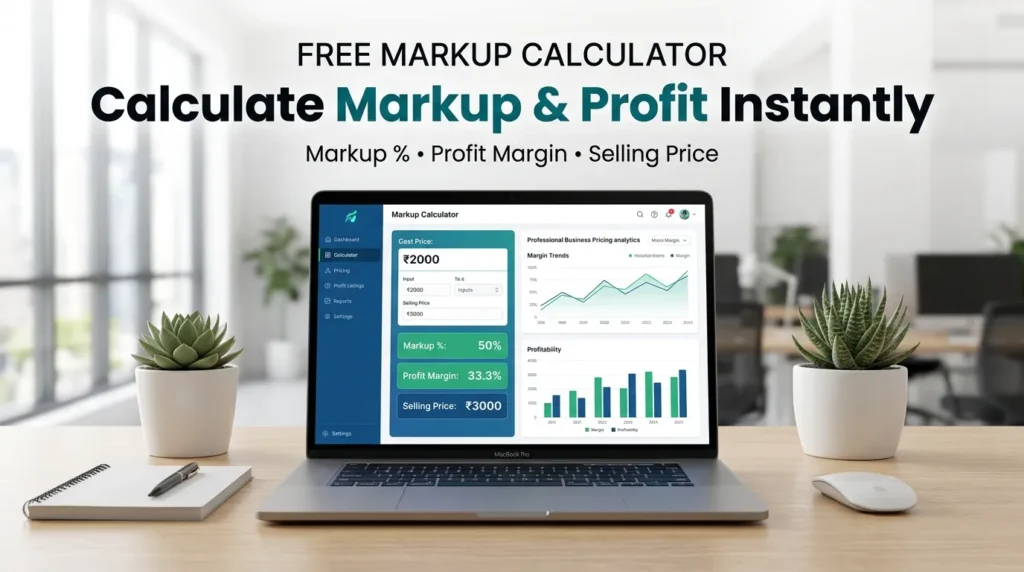
Use the Markup Calculator
This section explains how to use a markup calculator to determine your pricing structure.
Enter Your Pricing Information
A typical markup calculator percentage tool requires a few basic inputs to generate results. These values help determine profit margins and pricing performance.
Inputs usually include:
- Cost price
- Selling price
- Markup percentage
- Margin
A markup calculator margin automatically converts these values to show profit insights.
Cost Price (COGS)
The cost price, also called COGS (Cost of Goods Sold), represents the total cost required to produce or purchase a product.
This may include:
- Raw materials
- Manufacturing costs
- Labor costs
- Supplier purchase price
- Packaging expenses
Understanding your cost price is critical before calculating markup.
Example:
| Expense Type | Cost |
| Raw Materials | $20 |
| Labor | $15 |
| Packaging | $5 |
| Total Cost Price (COGS) | $40 |
A markup calculator uses this cost value to determine selling price and profit.
Selling Price / Revenue
The selling price refers to the final amount customers pay for a product. This value determines your business revenue.
Selling price is calculated by adding markup to the cost price.
Example:
Cost Price = $40
Markup = 50%
Selling Price = $60
This ensures the business earns profit while covering costs.
Markup Percentage
The markup percentage calculator determines how much profit is added to the cost price.
Markup shows how much higher the selling price is compared to cost.
Example:
- Cost Price = $50
- Selling Price = $75
Markup Percentage = 50%
Businesses use percentage markup to maintain consistent pricing strategies.
Calculator Results
A profit margin markup calculator usually provides the following results:
- Markup percentage
- Gross profit
- Profit margin
- Selling price
These results help business owners analyze pricing performance quickly.
What Is Markup? (Markup Definition Explained)
Many people ask what is markup in business.
The markup definition refers to the difference between a product’s cost price and its selling price.
In simple terms, markup meaning is the amount added to cost to determine selling price.
Example:
- Cost Price = $40
- Selling Price = $60
- Markup = $20
Markup is usually expressed as a percentage of cost.
Businesses use markup to ensure they earn profit after covering expenses.
Markup Formula
The markup formula is straightforward and widely used in pricing calculations.
Markup Formula
Markup = ((Selling Price − Cost Price) / Cost Price) × 100
This markup percentage formula converts profit into a percentage relative to cost.
Example:
Selling Price = $75
Cost Price = $50
Markup = ((75 − 50) / 50) × 100
Markup = 50%
How to Calculate Markup
Understanding how to calculate markup helps businesses price products correctly.
Step 1 – Determine Cost Price
First, calculate the total cost price of producing or purchasing a product.
Include:
- Material cost
- Labor
- Shipping
- Packaging
Step 2 – Determine Selling Price
Next, determine how much you plan to sell the product for.
The selling price should cover:
- Cost price
- Overhead expenses
- Desired profit
Step 3 – Apply the Markup Formula
Now apply the formula to calculate markup percentage.
Example:
Cost = $40
Selling Price = $60
Markup = ((60 − 40) / 40) × 100
Markup = 50%
How to Calculate Selling Price Using Markup
Businesses often need to calculate selling price from cost and markup.
The formula is:
Selling Price = Cost Price × (1 + Markup%)
Example:
Cost Price = $40
Markup = 50%
Selling Price = 40 × (1.5)
Selling Price = $60
This method is widely used in retail pricing.
How to Calculate Cost Price from Selling Price and Markup
Sometimes businesses know the selling price but want to find the cost.
Formula:
Cost Price = Selling Price / (1 + Markup%)
Example:
Selling Price = $75
Markup = 50%
Cost Price = 75 / 1.5
Cost Price = $50
This helps businesses analyze supplier pricing.
Markup vs Margin – Key Differences
Many people confuse markup vs margin, but they are different metrics.
| Metric | Based On |
| Markup | Cost |
| Margin | Selling Price |
Markup focuses on how much profit is added to cost.
Margin focuses on how much profit remains after sales.
Understanding margin vs markup is essential for financial analysis.
Markup Percentage vs Profit Margin
The debate between profit margin vs markup often causes confusion.
Example:
Cost = $50
Selling Price = $75
Markup = 50%
Profit Margin = 33.3%
Even though markup is 50%, the margin is lower because margin uses selling price as the base.
Businesses monitor both metrics to evaluate profitability.
Examples of Markup Calculation
Let’s look at a simple markup example.
Example:
Cost = $50
Selling Price = $75
Calculation:
Markup = ((75 − 50) / 50) × 100
Markup = 50%
Gross Profit = $25
This example shows how markup affects final pricing.
What Is a Good Markup Percentage?
A good markup percentage depends on the industry.
Typical ranges include:
| Industry | Average Markup |
| Retail | 50% |
| Restaurants | 60–300% |
| Clothing | 100–300% |
| Automotive Parts | 30–60% |
These industry markup rates vary based on demand, competition, and costs.
Markup in Pricing Strategy
Markup plays a key role in pricing strategy.
Many businesses use cost plus pricing, which means:
Selling Price = Cost + Markup
This method ensures every product generates profit.
However, companies should also consider:
- Market demand
- competitor pricing
- customer perception
A balanced pricing strategy helps businesses stay competitive.
Factors That Affect Markup
Several factors influence markup decisions.
Cost of Goods Sold (COGS)
Higher COGS often requires higher markup to maintain profitability.
Overhead Costs
Expenses such as rent, utilities, and salaries are considered overhead costs.
These costs must be covered through markup.
Market Demand
High demand products often support higher markup.
Competitor Pricing
Businesses must monitor competitors to maintain competitive pricing.
Customer Perception
Premium brands may apply higher markup due to perceived value.
Markup by Industry
Different industries use different markup structures.
Examples:
| Industry | Typical Markup Rates |
| Retail | 50% |
| Restaurants | 200–300% |
| Jewelry | 100–400% |
| Clothing | 100–250% |
Understanding markup by industry helps businesses set realistic pricing.
Benefits of Using a Markup Calculator
Using a markup calculator offers many advantages.
Benefits include:
- Faster pricing calculations
- Reduced human error
- Better profit planning
- Improved pricing accuracy
- Quick comparison between margin and markup
For businesses handling many products, this tool saves significant time.
Common Pricing Mistakes When Using Markup
Some businesses misuse markup and lose profit.
Common mistakes include:
- Ignoring overhead costs
- Confusing margin with markup
- Underpricing products
- Copying competitor prices blindly
Avoiding these errors helps maintain healthy profit margins.
Business Use Cases for Markup Calculators
Many businesses rely on markup calculators daily.
Retail Businesses
Retail stores calculate markup for thousands of products.
Service Businesses
Service providers use a service markup calculator to price labor and materials.
Repair Shops
Repair shops often use a parts markup calculator to price spare parts.
E-commerce Stores
Online stores use markup calculators to maintain competitive pricing.
FAQs
What is markup?
Markup is the difference between cost price and selling price, expressed as a percentage of cost.
What is a good markup percentage?
A good markup depends on the industry. Retail businesses often use around 50%, while restaurants may exceed 200%.
What is the difference between margin and markup?
Markup is based on cost price, while margin is based on selling price.
How do I calculate markup percentage?
Use the formula:
Markup = ((Selling Price − Cost Price) / Cost Price) × 100
What does 100% markup mean?
A 100% markup means the selling price is double the cost price.
Example:
Cost = $50
Selling Price = $100
How do I calculate profit from markup?
Profit is simply the difference between selling price and cost price.
Profit = Selling Price − Cost Price
Related Business Calculators
Businesses often use other financial tools alongside markup calculators:
These tools help improve overall financial planning.
Sources & References
To ensure accurate pricing strategies, consult reliable financial resources such as:
- Business pricing textbooks
- Accounting references
- Financial analysis guides
You can also learn more about pricing strategies from Investopedia
https://www.investopedia.com