Cap Rate Calculator
Real estate investors rely on data to make profitable decisions. One of the most important metrics used in property investment analysis is the cap rate calculator. This tool helps investors quickly evaluate how profitable a property might be before buying it.
Whether you’re analyzing an apartment, rental house, or commercial building, a capitalization rate calculator allows you to estimate returns based on income and property value.
In this guide, you’ll learn how to use a cap rate calculator real estate tool, understand the formula behind it, and discover how investors use it to analyze rental property investments.
Free Cap Rate Calculator (Instant Real Estate ROI Analysis)
A free cap rate calculator helps investors quickly calculate cap rate and estimate the potential return of a property investment.
In cap rate real estate investing, investors want to know how much income a property generates compared to its value. A cap rate calculator simple tool makes this process easy and fast.
Instead of manually performing calculations, the calculator automatically estimates profitability by analyzing:
- Property value
- Rental income
- Operating expenses
- Net operating income (NOI)
Real estate investors use this metric to evaluate property profitability and determine whether a rental property is worth buying.
For example, if two properties generate the same income but have different prices, the cap rate helps identify which investment offers better returns.
A cap rate calculator is particularly useful for:
- Rental property return estimation
- Comparing multiple properties
- Evaluating real estate market opportunities
- Analyzing risk vs reward in investments
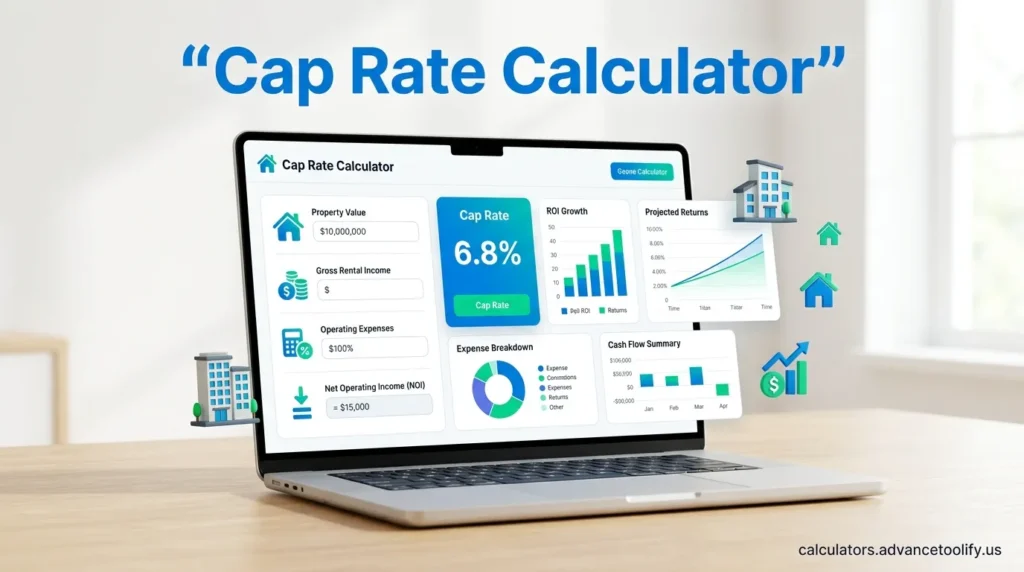
Use the Cap Rate Calculator
Below is a simplified breakdown of how a cap rate calculator works.
Property Value / Purchase Price
The first step in using a calculator is entering the property value.
This can include:
- Purchase price of the property
- Current market value
- Estimated property valuation
Investors often analyze both purchase price and market value to understand potential investment performance.
For example:
| Input | Example |
| Purchase Price | $300,000 |
| Market Value | $320,000 |
Using the correct property value ensures accurate cap rate calculations.
Rental Income
Next, you must enter the income generated by the property.
Typical inputs include:
- Monthly rent
- Gross rental income
- Gross income
Example:
| Income Type | Amount |
| Monthly Rent | $2,000 |
| Annual Gross Rental Income | $24,000 |
The gross rental income represents the total money collected before expenses.
Operating Expenses
Operating expenses are costs required to maintain and operate the property.
Common operating expenses include:
- Property taxes
- Insurance
- Management fees
- Maintenance costs
- Utilities
- HOA fees
Example of annual operating expenses:
| Expense Type | Annual Cost |
| Property Taxes | $3,000 |
| Insurance | $1,200 |
| Maintenance | $2,000 |
| Property Management | $2,500 |
| Utilities | $1,300 |
Total operating expenses = $10,000
These costs are subtracted from rental income to calculate the net operating income.
Cap Rate Results
After entering the inputs, the cap rate calculator displays results such as:
- Cap rate percentage
- Net operating income (NOI)
- Gross income
- Property value
The calculator works like a net operating income calculator, automatically computing the estimated cap rate.
Example result:
| Metric | Value |
| Property Value | $300,000 |
| Gross Income | $24,000 |
| Operating Expenses | $10,000 |
| Net Operating Income | $14,000 |
| Estimated Cap Rate | 4.67% |
What Is Cap Rate in Real Estate?
Many new investors ask what is cap rate and why it matters.
The cap rate definition refers to the percentage return expected from a real estate investment based on its net income.
In simple terms:
Cap rate shows how much income a property generates relative to its value.
In cap rate in real estate, investors use this metric to:
- Evaluate investment opportunities
- Compare properties
- Measure risk level
- Estimate potential returns
For example, a property with a 7% cap rate generally produces higher income compared to one with a 4% cap rate, assuming similar conditions.
However, higher cap rates often come with higher risk.
Cap Rate Formula
The cap rate formula is straightforward and widely used in real estate analysis.
Cap Rate = Net Operating Income ÷ Property Value
This capitalization rate formula calculates the expected annual return based on property income.
Example:
| Item | Amount |
| Net Operating Income | $18,000 |
| Property Value | $300,000 |
Cap Rate = 18,000 ÷ 300,000 = 0.06 (6%)
This means the property generates a 6% annual return.
How to Calculate Cap Rate
If you’re wondering how to calculate cap rate, the process involves three simple steps.
Step 1 – Calculate Net Operating Income (NOI)
The first step is determining net operating income.
NOI is calculated by subtracting operating expenses from gross rental income.
NOI Formula
Net Operating Income = Gross Income – Operating Expenses
Example:
Gross Income = $24,000
Expenses = $6,000
NOI = $18,000
This step is critical when you calculate NOI for cap rate.
Step 2 – Determine Property Value
Next, determine the property value.
This could be:
- Purchase price
- Current market value
- Appraised property value
Accurate property value ensures realistic investment analysis.
Step 3 – Apply the Cap Rate Formula
Finally, apply the formula.
Cap Rate = NOI ÷ Property Value
Example:
NOI = $18,000
Property Value = $300,000
Cap Rate = 6%
This percentage represents the expected return on the property investment.
Why Cap Rate Matters for Real Estate Investors
For investors, understanding the investment property return is critical.
The cap rate provides a quick way to measure rate of return on investment property.
Here’s why it matters:
1. Property Profitability
Cap rate quickly indicates whether a property generates strong income.
2. Investment Comparison
Investors often compare multiple properties using cap rate.
3. Risk vs Return
Higher cap rates often mean:
- Higher returns
- Higher investment risk
Lower cap rates often mean:
- Stable markets
- Lower risk investments
Example of Cap Rate Calculation
Let’s walk through a cap rate example.
Example scenario:
| Property Metric | Value |
| Property Value | $300,000 |
| Net Operating Income | $18,000 |
Using the formula:
Cap Rate = NOI ÷ Property Value
Cap Rate = 18,000 ÷ 300,000
Cap Rate = 6%
This calculate cap rate example shows the property produces a 6% annual return.
What Is a Good Cap Rate?
Investors often ask what a good cap rate is.
The answer depends on location, market conditions, and risk tolerance.
Typical ranges include:
| Cap Rate | Investment Risk |
| 4–6% | Low risk |
| 6–8% | Moderate risk |
| 8–12% | Higher return / higher risk |
For many investors, a good cap rate for rental property falls between 6% and 8%.
Cap Rate for Rental Properties
The cap rate rental property analysis focuses on rental income and operating costs.
Key factors include:
- Rental income stability
- Vacancy rates
- Property maintenance costs
- Local rental demand
Using a cap rate calculator rental tool allows investors to quickly estimate whether a rental property will generate profitable returns.
Commercial Real Estate Cap Rate
Commercial properties also rely heavily on cap rate analysis.
Examples include:
- Office buildings
- Retail spaces
- Industrial properties
- Apartment complexes
A commercial real estate cap rate calculator helps investors compare large property investments and determine which opportunities offer better income potential.
Cap Rate vs ROI vs Cash-on-Cash Return
Real estate investors use several metrics.
Here’s a comparison:
| Metric | What it Measures |
| Cap Rate | Property income potential |
| ROI | Overall investment return |
| Cash-on-Cash Return | Return on invested cash |
Cap rate vs ROI comparisons help investors evaluate both income and total return.
Similarly, cap rate vs cash-on-cash return helps analyze financing impact.
Cap Rate vs Gross Rent Multiplier (GRM)
Another metric used in property analysis is the gross rent multiplier.
Cap rate vs gross rent multiplier comparison:
| Metric | Focus |
| Cap Rate | Net income analysis |
| GRM | Gross rent vs property price |
GRM is faster but less detailed, while cap rate provides a more accurate profitability estimate.
Cap Rate Applications in Real Estate
Cap rate plays an important role in property investment decisions.
Estimating Property Value
Investors often use cap rate to estimate property value.
Property valuation using cap rate is common in commercial real estate.
Comparing Investment Opportunities
Cap rate allows investors to compare multiple investment properties quickly.
Assessing Investment Risk
Different markets have different average cap rates.
Higher cap rates usually indicate higher risk.
Measuring Investment Return
Cap rate provides a quick estimate of annual income relative to property value.
Factors That Affect Cap Rates
Several factors influence cap rates in the real estate market.
Interest Rates
Changes in interest rates can affect property values and investor demand.
This is why interest rates impact cap rate significantly.
Market Demand
High demand often reduces cap rates because property prices increase.
These market trends impact cap rate across cities and regions.
Rental Income Changes
If rents increase, NOI rises, which increases cap rates.
Property Location
Location strongly influences rental demand and property value.
Prime locations often have lower cap rates but stable income.
Limitations of Cap Rate
Despite its usefulness, cap rate has limitations.
Common cap rate limitations include:
- Ignores mortgage financing
- Ignores property appreciation
- Ignores future income growth
Because of this, investors often combine cap rate with other metrics.
Common Mistakes When Using Cap Rate
Investors sometimes misuse cap rate analysis.
Common mistakes include:
Using gross income instead of NOI
Cap rate must use net operating income, not gross rent.
Underestimating expenses
Ignoring maintenance or vacancy costs can distort results.
Comparing different markets
Cap rates vary widely across cities and property types.
Cap Rate FAQs
Does cap rate include mortgage payments?
No. Cap rate only uses net operating income and property value. Mortgage payments are not included.
Can cap rate be negative?
Yes. If operating expenses exceed rental income, the cap rate can become negative.
Is a higher cap rate always better?
Not necessarily. Higher cap rates often mean higher risk, lower demand, or unstable markets.
Should I use cap rate for short-term rentals?
Cap rate can be used for short-term rentals, but income fluctuations may make results less predictable.
How often should I recalculate cap rate?
Investors typically recalculate cap rate:
When rental income changes
When expenses increase
When property value changes
Related Calculators
To improve investment analysis, investors often use multiple tools together:
You can also explore advanced real estate metrics using tools like this guide from Investopedia:
https://www.investopedia.com/terms/c/capitalizationrate.asp
Using multiple calculators provides a more complete investment analysis.